
I am currently writing a paper on Genesis 28:10-22 and I find myself continually drawn to it. To give you some context, this is the portion of Jacob’s story where he is fleeing the wrath of Esau. Jacob long ago extorted his brother out of his birthright over a bowl of soup. The birthright was the custom that gave the firstborn son the right of being the next family patriarch with a double portion of the inheritance with which he could financially support the family. Esau had no interest in being responsible for the family – even when it came with the extra inheritance – and so he gave it up for the instant gratification to his belly. Later, Jacob went along with a scheme devised by his mother to steal the blessing his father wanted to give to Esau. It was this which drove Esau to devise his own scheme to murder Jacob after their father’s death.
Genesis 28 opens there, with Jacob running for his life, owning the promise of fortune and power but truly having nothing more than he could carry for the long journey to Haran. Jacob, the tent-dweller and momma’s boy, found himself destitute and alone in the wild for the first time, with nothing but chaos left behind him.
Let’s enter into Genesis 28:10-22 ESV:
10 Jacob left Beersheba and went toward Haran. 11 And he came to a certain place and stayed there that night, because the sun had set. Taking one of the stones of the place, he put it under his head and lay down in that place to sleep. 12 And he dreamed, and behold, there was a ladder set up on the earth, and the top of it reached to heaven. And behold, the angels of God were ascending and descending on it! 13 And behold, the Lord stood above it and said, “I am the Lord, the God of Abraham your father and the God of Isaac. The land on which you lie I will give to you and to your offspring. 14 Your offspring shall be like the dust of the earth, and you shall spread abroad to the west and to the east and to the north and to the south, and in you and your offspring shall all the families of the earth be blessed. 15 Behold, I am with you and will keep you wherever you go, and will bring you back to this land. For I will not leave you until I have done what I have promised you.” 16 Then Jacob awoke from his sleep and said, “Surely the Lord is in this place, and I did not know it.” 17 And he was afraid and said, “How awesome is this place! This is none other than the house of God, and this is the gate of heaven.”
18 So early in the morning Jacob took the stone that he had put under his head and set it up for a pillar and poured oil on the top of it. 19 He called the name of that place Bethel, but the name of the city was Luz at the first. 20 Then Jacob made a vow, saying, “If God will be with me and will keep me in this way that I go, and will give me bread to eat and clothing to wear, 21 so that I come again to my father’s house in peace, then the Lord shall be my God, 22 and this stone, which I have set up for a pillar, shall be God’s house. And of all that you give me I will give a full tenth to you.”
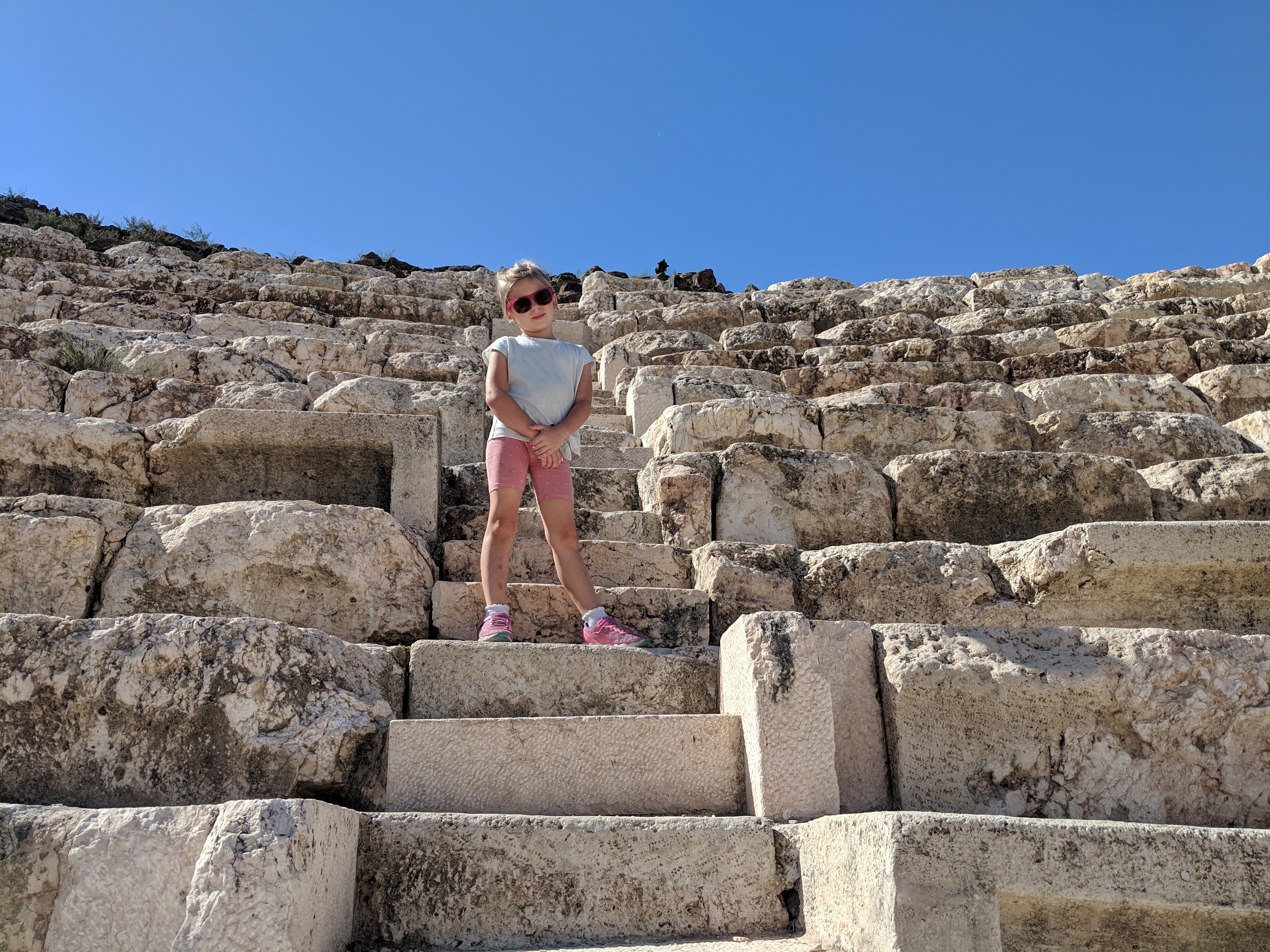
In his vulnerable state, Jacob dreams of a ladder where angels ascended and descended upon it. Though the ESV calls this a “ladder,” scholars explain that this is better understood as a stairway that looks like the ancient NE ziggurat which was so prevalent in ancient Mesopotamia.
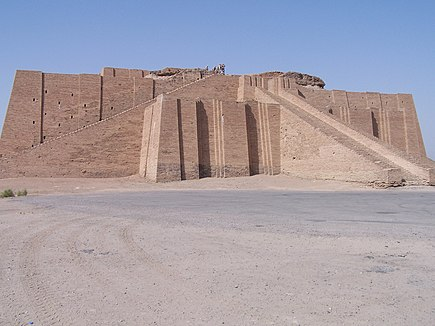
Why does that matter? The purpose of a ladder is that one may climb it to reach something up high. However, the purpose of the ziggurat was the opposite: it was created with a flat top which functioned as a temple where the god resided. The stairway was so the gods could come down to earth and be amongst the humans who worshipped them.
In Jacob’s vision, the stairway would have been a familiar symbol which communicated God’s intentional descent from his heavenly throne room to the dirt where Jacob lay his head in order to speak to him. It communicated the idea that God saw Jacob, miserable in the pit of consequences he brought upon himself, and he chose to go to him with an invitation.
Where Jacob has strived with selfishness and greed, God offers generous gifts of grace and provision. Where Jacob is afraid, leaving everything he knows behind and traveling by himself into an unfamiliar land and an unfamiliar community, God offers the incredible promise of safety and the knowledge that Jacob will return to his home. More than anything, where Jacob is completely alone, God invites him into divine community with the promise that God will never leave his side.
God came to Jacob, the schemer, descending from the heavens so that the holy God of the universe could offered him a feast of grace complete with an anointed space where Jacob and his descendants may find God’s presence in the Promised Land. Jacob woke up in complete awe and worshiped, anointing the place as a sanctuary, calling it the gateway of heaven.
Jesus takes up this imagery in John 1:51 when he proclaims: “Truly, truly, I say to you, you will see heaven opened, and the angels of God ascending and descending on the Son of Man.”
Jacob understood the steps to be the gateway into heaven; Jesus proclaims that he will become that gateway. Through his death upon the cross, his blood flowed down carrying God’s promise of redemption to all people. Through Jesus’s resurrection and gift of the Spirit, the invitation into divine community was extended to all the peoples and nations of the world.
And what was Jacob’s response to the invitation of divine grace? He awoke in complete awe. He worshipped. He anointed the place as a sanctuary and made a vow, which repeated God’s promise back to him and joined himself to God for the rest of his life.
Maybe we find ourselves longing for that moment, when God issued that divine invitation to us and we were overwhelmed by his presence. But we tend to encounter only glimpses, foretastes, and fleeting moments punctuated by long stretches of seeming divine absence. When we look at the rest of Jacob’s story, God is not mentioned once during his many years in Haran – yet we know that God promised that he would never leave Jacob, not for one moment, and Jacob confirmed that God never once left him after this moment (Gen. 35:3) Like Jacob, Psalm 105:4 tells us to trust God, to seek the LORD and his strength, to seek his presence continually.
And maybe we find ourselves asking, “where can I find God’s presence?”
Isaiah 57:15 gives us God’s response:
For thus says the One who is high and lifted up,
who inhabits eternity, whose name is Holy:
“I dwell in the high and holy place,
and also with him who is of a contrite and lowly spirit,
to revive the spirit of the lowly,
and to revive the heart of the contrite.
We so often think in terms of legalism, where we must be perfect before meeting God. But that is not what we see in Scripture – of course we are called to live in a way which reflects God’s character to the world once we have accepted his invitation – but it is when we are broken open and humbled, where God most often lets us feel his presence. Jesus says, “Blessed are the pure in heart, for they shall see God.”
There is no room for false strength or arrogance in the throne room of God. Before him, the purest heart is vulnerable with the truth of its need and its desperation for Him. In that space, we encounter him and we find true worship.
Amen.
 Impartial Christian Ministries